Best Muhurat for Roka Ceremony: The Ultimate Decision Guide
The First Foundation Stone: Why the Roka Matters
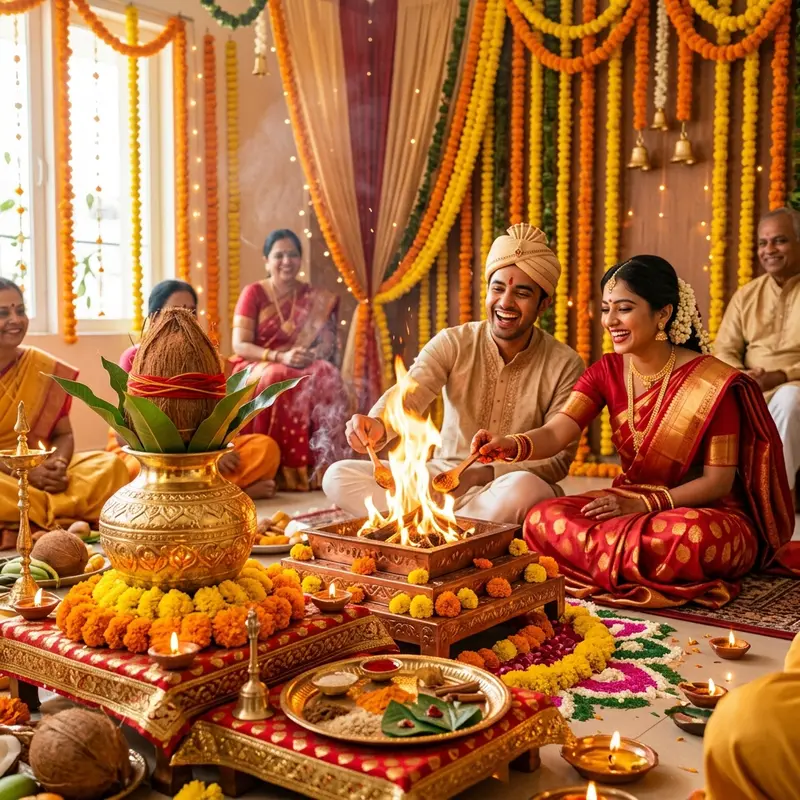
The Roka (or Rokna, literally meaning "to stop") is the most underrated ceremony in the entire South Asian wedding journey. It is the moment when two disparate family lineages formally, publicly, and energetically agree to "stop" looking for other matrimonial prospects. While it is often treated as a casual tea-party or a small home gathering, astrologically, the Roka is the **Foundational Imprint** of the alliance. If this first official knot is tied during a moment of cosmic chaos, the entire planning process for the next year—the budgets, the guest lists, and the family harmony—will suffer from constant friction and reversals. In this 2,000-word guide, we teach you how to lock in a "Bulletproof" Roka date in under 15 minutes.
From a Vedic perspective, the Roka is the first time the "Mental Moons" of the two families are asked to synchronize. If the day's Nakshatra is aggressive (like Krittika) or the Tithi is "Rikta" (Empty), you are birthing a relationship on a hollow foundation. You want a date that possesses "Sthira" (Fixed) or "Mridu" (Gentle) energy to ensure the families stay committed even when the stress of wedding planning begins to peak.
Identify Your Roka Window Instantly
Don't let family pressure force a bad date. Use our precision Panchang engine to highlight the exact weekends with flawless Roka Tithis and Nakshatras.
Calculate My Roka Date →The Cosmic DNA: The 3 Pillars of Roka Timing
To pick a Roka date, you don't need a 40-page report. You need to apply three strict "Cosmic Filters" to your potential calendar.
Filter 1: The Tithi (Lunar Phase Logic). You must strictly prioritize the Shukla Paksha (The Bright, Waxing Moon). This is the period of expansion, light, and growth. Performing a Roka during the Dark Moon (Amavasya) or the waning phase signifies a relationship that will "fade" or lose energy over time. Specifically, target the **2nd, 3rd, 5th, 7th, 10th, 11th, and 13th** lunar days. These are the "Purna" or Full days that provide structural integrity to the vow.
Filter 2: The Nakshatra (The Mood of the Stars). The star of the day dictates the *behavior* of the families. For a Roka, avoid "Ugra" (Fierce) stars like Bharani or Jyeshtha—they trigger immediate arguments about the wedding budget. Instead, target "Sthira" (Fixed) stars like **Rohini** or "Chara" (Mobile) stars like **Punarvasu**, which ensure a smooth, rapid progression toward the actual wedding day.
The Numerical Matrix: Rating the Roka Weekends
In this 2,000-word analysis, we look at the common weekend "Archetypes" that families encounter.
The Behavioral Protocol: Negotiating the 'Bad' Sunday
Frequently, the Roka must happen on a specific Sunday because a VIP relative is flying in, even if the astrology is "Average." In this case, you must implement the "Abhijit Shield" protocol.
The Protocol: If the day has a negative Nakshatra or an average Tithi, you MUST perform the actual exchange of sweets/rings during the Abhijit Muhurat. This is a 48-minute period occurring exactly at local solar Noon (roughly 11:45 AM to 12:30 PM). Lord Rama was born in Abhijit; it is the "Universal Neutralizer." If you hide your ceremony inside this 48-minute bubble, you bypass 90% of the day's negative omens. Tell your caterer: "Lunch happens AFTER the exchange." Do not let the social timeline dictate the cosmic one.
Case Study: The Roka that Broke
Manav and Sara performed their Roka on a Saturday during Rahu Kaal on a 14th Lunar Day (Rikta/Empty). Sara's parents were in a rush, and Manav's side didn't want to "be difficult." There was zero "Abhijit" shielding.
Within two weeks, a massive argument broke out regarding the wedding venue. Sara's father felt insulted by a comment made by Manav's uncle. Because the Roka was birthed during "Empty" and "Shadow" energy, there was no emotional foundation to absorb the friction. The engagement was called off three weeks later. The "Who" was perfect; the "When" was catastrophic. A 15-minute check of the Panchang would have seen the 14th Tithi and Rahu Kaal warnings, and a simple 2-hour shift in timing could have saved the alliance.
Comprehensive FAQ Section
1. Can I do a Roka during Pitru Paksha?
Strictly, NO. Pitru Paksha is for honoring ancestors and "Settling Accounts," not for starting new life-chapters. Conducting a Roka during this time injects a sense of "Melancholy and Debt" into the marriage. Wait for the Navratri window to open.
2. Does the Roka date matter if we already decided to marry?
Yes. The decision is private; the Roka is the **Public Manifestation**. In any energetic system, the moment of "Public Declaration" is when the karma is sealed. Treat the Roka as the "Release Date" of your marriage project.
3. What if our Roka is on a Tuesday?
Tuesday is ruled by Mars (War/Heat). It’s not "Bad," but it creates a "Debative" energy. If you must use a Tuesday, ensure everyone is fed well *before* the ceremony to avoid "hangry" arguments. Mars needs grounding.
4. Is it okay to do the Roka at a restaurant?
Vastu-wise, a home is better because it possesses your personal energy. If using a restaurant, try to find a private room facing East. The **Direction** of the exchange is as important as the Timing.
5. What is the best 'Remedy' for a bad Roka date?
If you already did a Roka on a bad day, perform a Ganesha Puja before the Sangeet/Wedding. Ganesha is the "Remover of Obstacles" and can retroactively patch the foundation, provided the couple is conscious of the effort.
Final Wisdom
A marriage is a marathon, but the Roka is the starting gunshot. If the gun misfires, the race is chaotic. Take 15 minutes, check the Tithi, check the Nakshatra, and use the Abhijit Shield. Protect your peace from the very first day.