Lal Kitab vs. Vedic Astrology: Core Differences, Chart Rules & Interpretations
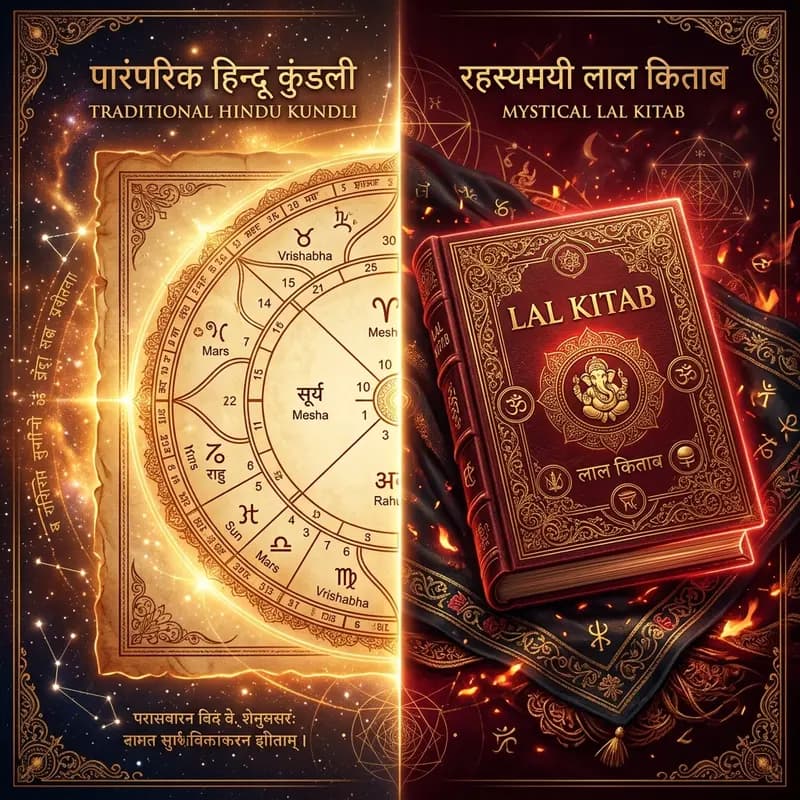
Lal Kitab vs. Vedic Astrology: Introduction
When entering the world of Indian astrology (Jyotish), most seekers are introduced to traditional Vedic astrology, also known as the **Parashari system**. However, there exists another highly popular, deeply mystical, and pragmatic system known as **Lal Kitab** (the Red Book). Compiled in five Urdu manuscripts in the mid-20th century, Lal Kitab has captured the fascination of millions due to its simple remedies and direct chart analysis. But how exactly does it differ from traditional Vedic astrology? What are the core chart rules, and how do you interpret a Lal Kitab chart? In this detailed guide, we will break down the structural, conceptual, and practical differences between these two powerful systems.
Calculate Your Lal Kitab Kundli
Discover your sleeping planets, ancestral debts (Rin), and get personalized Lal Kitab remedies instantly.
Try Free Lal Kitab GeneratorThe Core Difference: Chart Framework
The most fundamental structural difference between the two systems lies in the **ascendant (Lagna) and house alignment**:
Traditional Vedic Astrology (Parashari)
In Vedic astrology, the first house (Lagna) is determined by the zodiac sign rising on the eastern horizon at the exact minute and location of your birth. For example, if Virgo was rising, your first house contains Virgo (Sign 6), your second house contains Libra (Sign 7), and so on. The house lords change dynamically depending on the ascendant. This requires complex calculations involving nakshatras, degrees, and divisional charts (like the D9 Navamsa or D10 Career chart).
Lal Kitab Astrology
Lal Kitab discards the dynamic ascendant framework. In a Lal Kitab chart (Teowa), **the first house is always fixed to Aries (Sign 1)**, the second house to Taurus (Sign 2), and the twelfth house to Pisces (Sign 12). No matter what your rising sign was at birth, your Lal Kitab chart is drawn with Aries in the first house. The natal planets are then placed in the houses they occupied in your Vedic birth chart, but their sign-based lords are completely ignored. Instead, the planets are analyzed based on their **house positions, permanent houses (Pucca Ghar), and aspect rules**.
Key Rules of Lal Kitab Chart Analysis
To read a Lal Kitab chart, you must understand its unique vocabulary and analytical rules. Here are the core concepts:
1. Pucca Ghar (Permanent Houses)
Lal Kitab assigns a "permanent home" or *Pucca Ghar* to every planet. When a planet is in its Pucca Ghar, it feels comfortable, behaves like a benevolent ruler, and gains natural strength. The permanent assignments are:
- First House: Sun — rules the self, physical health, and administrative power.
- Second House: Jupiter — rules ancestral legacy, family wealth, and speech.
- Third House: Mars — rules courage, siblings, and minor journeys.
- Fourth House: Moon — rules mother, peace of mind, domestic property, and savings.
- Fifth House: Jupiter — rules progeny, higher intelligence, and spiritual merits.
- Sixth House: Mercury & Ketu — rules diseases, maternal relations, and hidden enemies.
- Seventh House: Venus & Mercury — rules spouse, marriage, and public relations.
- Eighth House: Mars & Saturn — rules longevity, accidents, and sudden changes.
- Ninth House: Jupiter — rules dharma, higher wisdom, and fortune.
- Tenth House: Saturn — rules career, social status, and father's occupation.
- Eleventh House: Jupiter — rules incoming wealth, elder siblings, and gains.
- Twelfth House: Rahu & Jupiter — rules foreign lands, expenditure, and hospitalizations.
2. Soya Grah and Soya Ghar (Sleeping Planets & Houses)
Unlike Vedic astrology where every planet is constantly active and casting aspects, Lal Kitab introduces the state of dormancy:
- Sleeping House (Soya Ghar): Any house that has no planet inside it and receives no planetary aspect is considered "sleeping." Its energy remains dormant. It is only activated when a planet transits through it or when a specific remedy is performed.
- Sleeping Planet (Soya Grah): A planet is considered sleeping if it does not cast an aspect on any other planet or house, or if its companion house (its activator) is empty. For example, if the 7th house is empty, Venus or Mercury in the 1st house is considered sleeping and cannot deliver its effects. Waking up a sleeping planet is done by performing custom lifestyle remedies.
3. Lal Kitab Aspects (Drishti)
Vedic astrology uses the concept of planetary aspects where every planet looks at the 7th house from itself, and Saturn, Mars, and Jupiter have special aspects (3/10, 4/8, and 5/9 respectively). Lal Kitab uses **fixed directional aspects** that are entirely different:
- Planets in the 1st house aspect the 7th house (and vice versa).
- Planets in the 4th house aspect the 10th house.
- There are unique "half-aspects" and "joint aspects" based on house numbers, creating a flow of energy that is strictly numerical rather than sign-based.
The Meaning of the 12 Houses in Lal Kitab
Each house in Lal Kitab has a distinct symbolic name and governs specific areas of human life:
- House 1 (Tanu Ghar): Represents the native's health, brain, appearance, and self-confidence. Known as the throne of the king.
- House 2 (Dhana Ghar): Represents inheritance, wealth, family values, and gold. Governed by Jupiter.
- House 3 (Sahaj Ghar): Represents siblings, courage, weapons, and self-made efforts. Governed by Mars.
- House 4 (Sukh Ghar): Governs mother, home, ancestral property, and peace. It is the lake of nectar.
- House 5 (Suta Ghar): Governs children, intelligence, future plans, and wisdom. Represented by Jupiter.
- House 6 (Ripu Ghar): Covers diseases, service, maternal relatives, and minor court issues. Ruled by Mercury and Ketu.
- House 7 (Kalatra Ghar): Marriage, spouse, partners, and business transactions. Governed by Venus.
- House 8 (Mrityu Ghar): Longevity, sudden blockages, underground wealth, and chronic ailments. Ruled by Mars and Saturn.
- House 9 (Dharma Ghar): Represents fortune, father, pilgrimage, and divine protection. Governed by Jupiter.
- House 10 (Karma Ghar): Career, professional status, government relations, and work ethics. Governed by Saturn.
- House 11 (Labha Ghar): Gains, cash inflow, desires fulfilled, and incoming support. Governed by Jupiter.
- House 12 (Vyaya Ghar): Expenses, sleep, bedroom comfort, and foreign connections. Governed by Rahu.
Special Chart Categories in Lal Kitab
Lal Kitab categorizes birth charts based on critical planetary combinations that dictate how destiny operates:
- Dharmi Teowa (Righteous Chart): Occurs when Jupiter is in the 1st, 5th, 9th, or 12th house, or when Saturn is in the 11th house. In a Dharmi Teowa, even negative planetary combinations fail to deliver their malefic results, as divine protection is highly active.
- Andha Teowa (Blind Chart): Occurs when two enemy planets (e.g., Sun and Saturn) are placed in the 10th house, or when the 10th house has malefic aspects. The native struggles to find stable career direction and repeatedly makes poor business decisions.
- Nabalig Teowa (Minor Chart): Occurs when the 1st, 4th, 7th, or 10th houses contain no planets, or when mercury is in the 1st or 8th house. The chart is considered immature; predictions should not be made until the person reaches 24 years of age.
The Lal Kitab Concept of Varshphal (Yearly Progression)
A central feature of Lal Kitab is the **Varshphal** or the Annual Progressed Chart. Unlike Vedic Varshphal which calculates the exact moment the transit Sun returns to its natal longitude (requiring complex calculation), the Lal Kitab Varshphal operates on a highly unique **35-year cycle**. Each planet has a pre-determined pathway of progression through the houses based on the native's age. For example, if you are 28 years old, your planets shift to specific houses according to a fixed mathematical table. The Varshphal chart operates for exactly one solar year (from birthday to birthday) and indicates which natal placements will be activated and which sleeping planets will wake up. It is the primary tool used by Lal Kitab astrologers to predict yearly events and schedule specific remedies.
Comparison Table: Vedic vs. Lal Kitab
| Feature | Traditional Vedic Astrology | Lal Kitab System |
|---|---|---|
| Ascendant (Lagna) | Dynamic (changes every 2 hours based on birth time) | Fixed (Aries is always the 1st House/Lagna) |
| Planetary Aspects | Based on sign distance (7th, plus special 3/10, 4/8, 5/9) | Based on fixed house pathways (directional flow) |
| Divisional Charts | Uses 16 charts (D9, D10, D12, etc.) for micro-analysis | Uses only the single fixed-house Teowa (chart) |
| Remedial Measures | Pujas, Mantras, Yagnas, expensive Gemstones | Simple, inexpensive daily/continuous karmic Upays |
| Dasha System | Vimshottari Dasha (120-year cycle based on Moon Nakshatra) | Lal Kitab 35-year cycle or Varshphal (yearly chart) |
The Philosophy of Lal Kitab Remedies
In Vedic astrology, a malefic planet is often pacified by chanting mantras or wearing a gemstone to strengthen it. Lal Kitab operates on the principle of **planetary relocation and subtraction**:
Lal Kitab believes that you cannot alter your core destiny, but you can alter the *expression* of planetary energies. For example, if a malefic planet is sitting in your 5th house causing child-related problems, you can perform a remedy to "shift" its energy to a neutral house like the 12th. This is done using physical items as carriers of planetary vibrations. Putting a copper coin in running water, keeping a silver square piece in your pocket, or feeding stray dogs are examples of relocating planetary energies to mitigate their direct malefic impact.
Conclusion
Both Vedic Astrology and Lal Kitab are highly accurate, but they serve different temperaments. Vedic astrology is a deep, academic, and mathematical study of your soul's journey across divisions of time. Lal Kitab is a practical, quick diagnostic tool designed to identify immediate blocks and provide highly accessible, daily-life remedies. Generating both charts gives you the ultimate astrological toolkit. Use our free Lal Kitab generator today to compare your charts and find your custom remedies!