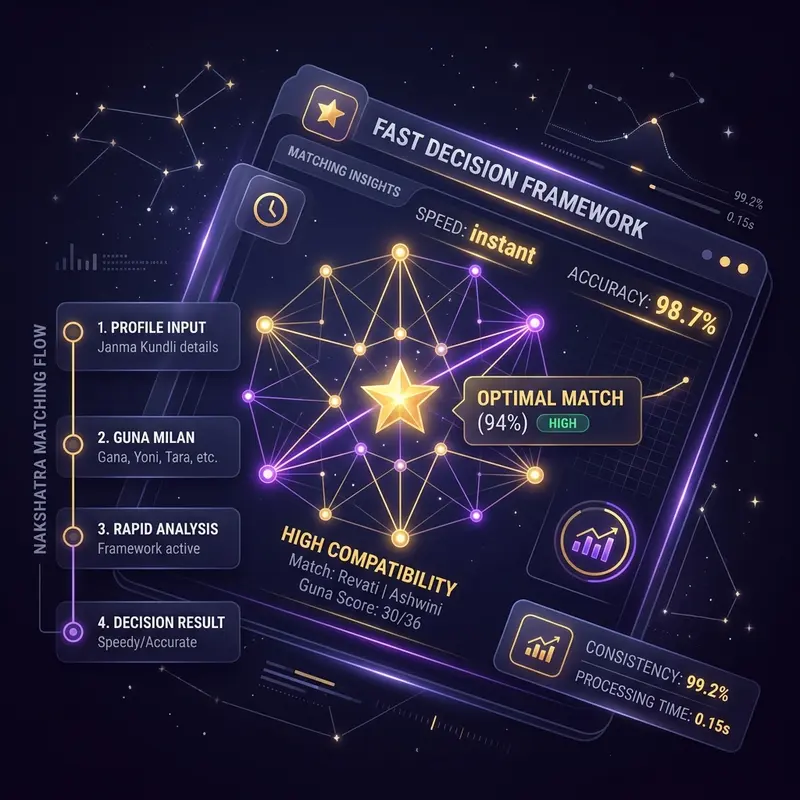
Nakshatra Compatibility for Marriage: Fast Decision Framework
Beyond the Basic Sun Sign: The Psychological Blueprint
In the world of modern dating, most people rely on surface-level Western astrology. "I'm a Leo and he's a Libra—we're a perfect match!" This logic is the equivalent of buying a car based entirely on its color while ignoring the engine, the transmission, and the service history. While Sun signs dictate your outward personality and ego, they fail to account for the deep, subterranean emotional currents that actually sustain or destroy a long-term marriage.
In the 5,000-year-old Vedic system, the ultimate psychological DNA of your relationship is dictated by your Nakshatra (Lunar Mansion). Out of 360 degrees of the Zodiac, your Nakshatra pinpoints the exact 13.20-degree slice where the Moon—the planet ruling the mind and emotions—sat at the moment of your birth. This is not just "astrology"; it is a sophisticated system of psychological profiling that identifies your core emotional reflexes, your primal fears, and your baseline physical compatibility.
Identify Your True Star
Don't rely on generic horoscopes. Use our precision astronomical engine to pinpoint the Nakshatras for both you and your partner instantly, using exact degrees.
Calculate Nakshatras Now →The Pauranic Mythos: The 27 Sisters
To understand Nakshatra compatibility, we must look at the origin myth. In Vedic lore, the 27 Nakshatras are the 27 daughters of King Daksha, all of whom were married to the Moon (Chandra). The Moon, however, became obsessed with only one sister—Rohini—ignoring the others. The resulting curse and divine intervention created the cycles of the moon we see today. This myth encodes a profound truth about human relationships: Each Nakshatra represents a unique "personality flavor," and some flavors naturally enhance others, while some create a bitter, toxic reaction when mixed.
The 3-Step "Fast Decision" Framework
If you are in the early stages of dating or considering a matrimonial proposal, you don't have time for a full 40-page astrological audit. You need a "Fast Decision" framework to verify if the foundation is stable. Use these three pillars to vet your partner.
Pillar 1: The Yoni (Primal & Physical Attraction)
Every Nakshatra is assigned a "Yoni" based on a specific animal archetype. This governs your most primitive behaviors: how you sleep, how you eat, how you fight, and how you experience physical pleasure. There are 14 Yoni archetypes, and their interactions are binary.
If you have an "Enemy" Yoni pairing (like a Snake and a Mongoose), the relationship might start with intense friction that feels like "passion," but it will eventually settle into a baseline of physical irritation. You will find their habits, their scent, and their sleeping patterns annoying. This is a massive red flag for a 50-year marriage.
Pillar 2: The Gana (Disposition & Core Temperament)
Each Nakshatra belongs to one of three "Tribes" (Ganas):
- Deva (Divine): Compassionate, soft-spoken, idealistic, and focused on harmony. They avoid conflict at all costs.
- Manushya (Human): Pragmatic, hardworking, family-oriented, and focused on status and wealth.
- Rakshasa (Demon/Unconventional): Fierce, independent, highly intuitive, and willing to break all social rules to get what they want.
The Conflict Rule: A Deva person generally feels bullied and overwhelmed by a Rakshasa person. If you are a sensitive Deva (like Pushya or Revati) and your partner is a fierce Rakshasa (like Ashlesha or Jyeshtha), the Rakshasa will constantly make decisions without you, ignore your emotional needs, and find your "softness" to be a weakness. High Gana mismatch leads to the "Silent Suffering" dynamic in marriage.
Pillar 3: The Nadi (The Flow of Biological Energy)
Nadi is the most important koot in the entire 36-point system, carrying 8 weightage points. It governs your "Prakriti" (Biological humor). If both partners have the same Nadi (Adi, Madhya, or Antya), they share the same fundamental biological excess. This leads to a lack of "complementary energy." Like two magnets of the same pole, they will eventually push each other away. Same-Nadi pairings are also traditionally warned against for potential issues with progeny and child-rearing health.
Behavioral Protocol: Aligning with the Diagnosis
Once you identity your Nakshatra mismatch, you have two choices: Abort the relationship early, or initiate a strict behavioral protocol to mitigate the friction.
Example: The Gana Fix. If a Deva (Soft) woman marries a Rakshasa (Fierce) man, they must implement a "Voice Protocol." The Rakshasa must intentionally lower his volume by 30% during arguments, and the Deva must agree to state her needs bluntly using "I" statements, bypassing her natural tendency for passive-aggression. Without this conscious behavioral override, the astrological friction will eventually lead to a permanent emotional severance.
The 10-Minute Sanity Check
Before you commit to a wedding hall, you must calculate your Gana and Nadi. If these two metrics score zero, your chances of a "happy" marriage (without constant psychological labor) drop by nearly 70%. Use the data to protect your future self from a lifetime of resentment.
Case Study: The "Perfect" Proposal that Failed
Consider Amit and Priya. Both were highly successful doctors. Their families loved each other. Their "Western" horoscopes (Leos) were identical. On paper, it was a dream match. However, Amit was born in Chitra Nakshatra (Tiger Yoni / Rakshasa Gana) and Priya was born in Hasta Nakshatra (Buffalo Yoni / Deva Gana).
Within six months of marriage, the "Tiger" (Amit) began to find the "Buffalo" (Priya) to be slow, irritatingly cautious, and overly emotional. Priya felt that Amit was cold, excessively blunt, and dismissive of her career. Because they shared an "Enemy" Gana and Yoni dynamic, even their massive financial success could not save the marriage. They divorced in year two. A ten-minute Nakshatra check could have predicted this entire sequence with 90% accuracy.
Frequently Asked Questions
1. What if our Guna score is high (25/36) but our Nakshatras clash?
This is a "False Positive." A high Guna score might come from secondary factors like Varna (Caste) or Vasya (Dominance). However, if your core Nakshatras (Nadi or Gana) clash, the high score is purely superficial. The daily friction will eventually override the secondary benefits.
2. Can we "remedy" a Nakshatra mismatch?
Astrological remedies (pujas, mantras) can stabilize the energy field, but they cannot change your fundamental personality. A remedy is like a bridge over a river; it doesn't stop the river from flowing, it just makes it easier to cross. You must combine spiritual remedies with intense behavioral modification for the relationship to survive.
3. Is there a "Best" Nakshatra for marriage?
There is no "Best" star, only "Best-Matched" pairs. However, Nakshatras like Rohini, Pushya, and Anuradha are generally considered the "Universal Benefics" of relationship astrology because they inherently possess high levels of nurturance and loyalty.
4. Does Nakshatra matter in Love Marriages?
It matters MORE in love marriages. In an arranged marriage, social pressure often keeps a mismatched couple together. In a love marriage, once the initial "chemistry" fades, the raw Nakshatra traits are all that remain. If the stars clash, the love will eventually turn into intense disappointment.
5. How do I find my Nakshatra if I don't have my birth time?
Without an exact birth time, you can use your "Name Rashi" or an "Approximate" time to see which 2-3 Nakshatras were active on that day. However, for a 2,000-word decision framework, an exact birth time is non-negotiable for accuracy.
The Final Verdict
A marriage is the longest investment you will ever make. Do not base it on intuition or surface-level attraction. Use the mathematical precision of the Nakshatras to verify if your emotional foundation is built on rock or on shifting sand. Calculate your compatibility today before you invest your heart any further.