Same Nakshatra Marriage: Safe or Risky?
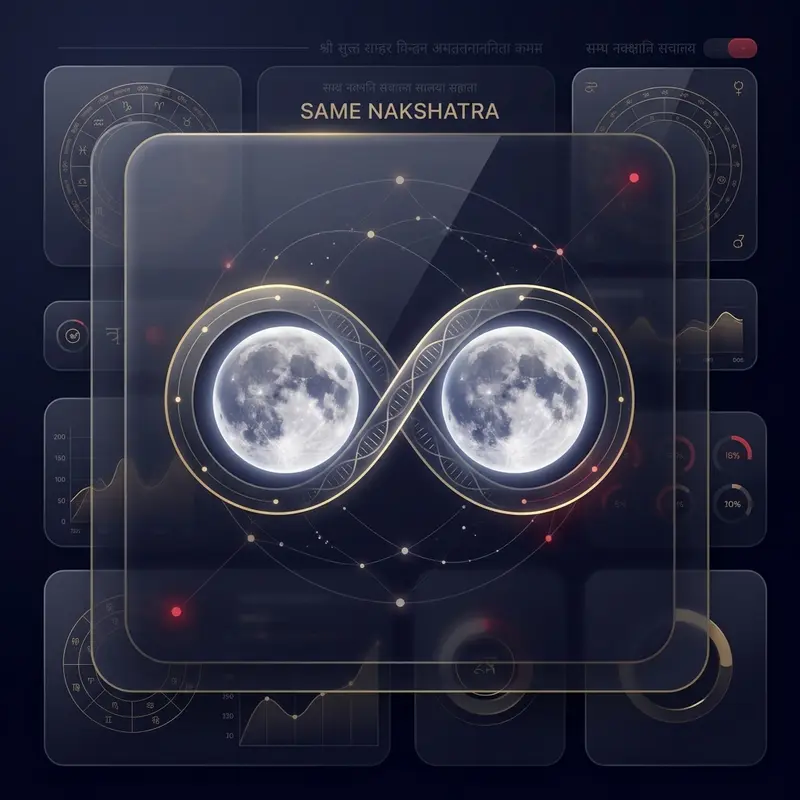
The Magnetism of the 'Twin Soul': A Spiritual Paradox
It is one of the most common romantic phenomena in Vedic astrology: being intensely, almost telepathically attracted to someone who shares your exact same Nakshatra. Because your Moons are sitting in the same 13.20-degree slice of the sky, your emotional processing, your communication rhythms, and even your subconscious fears are virtually identical. You finish each other’s sentences. You feel deeply, viscerally "understood" without ever having to explain yourself. To the modern romantic, this feels like finding a "Twin Soul."
However, when you take this "Twin Soul" to a traditional Vedic astrologer, they will often shake their head with concern. They will point to a terrifying-sounding technical term: Eka Nakshatra Dosha. In the 36-point Guna Milan system, sharing the same Nakshatra often triggers a Nadi Dosha, resulting in an automatic 0 points out of 8 for that category. This leaves couples in a state of panic: Is their perfect connection actually a cosmic curse? In this 2,000-word deep-dive, we will unravel the truth behind this paradox.
Check Your Nadi Cancellation
Not all same-star marriages are cursed. Use our advanced calculator to check if your specific Padas (Quarters) or planetary lordships cancel the Dosha instantly.
Check My Dosha →The Structural Problem: The Echo Chamber Effect
The primary reason Vedic texts warn against same-Nakshatra marriage is not "magic"; it is energetic redundancy. A relationship is meant to be a balancing act. In a perfect marriage, one person provides what the other lacks. If you are Fire, you need someone with Earth to ground you. If you are Water, you need someone with Air to move you.
In a same-Nakshatra marriage, you have no "balance." You have an **Echo Chamber**. If you are both born in a highly sensitive, over-thinking Nakshatra like Ashlesha, your household will not be "twice as romantic"; it will be twice as paranoid and tense. When a bad planetary transit hits the moon (like a harsh Shani Sade Sati), you will both experience peak depression and anxiety at the exact same moment. Frequently, there is no "strong partner" left to hold the other person up because the foundation of both partners is breaking simultaneously. This is the biological reality of Nadi Dosha.
The Case for the "Identical" Marriage
Despite the warnings, there are significant advantages to this pairing that modern couples must evaluate:
- Effortless Communication: You share the same mental dictionary. Misunderstandings, which destroy 90% of modern relationships, are virtually non-existent early on.
- Identical Life Goals: You naturally value the same things—whether it's career ambition, spiritual solitude, or massive family gatherings.
- Synchronized Sex Drive: Because you share the same Yoni (Animal Profile), your physical rhythm is naturally aligned, leading to high levels of initial sexual satisfaction.
The Hidden Exceptions: When It’s Actually Auspicious
Here is the secret that many generic astrology apps miss: Same-Nakshatra marriage is actually actively promoted and considered highly blessed if it happens in specific 'Safe Stars.' If both partners share one of these Nakshatras, the Nadi Dosha is ignored because these stars possess inherent spiritual stability:
The Absolute Danger Zones: The 'Ugra' Stars
If you both share a "Fierce" (Ugra) or "Sharp" (Tikshna) Nakshatra, the marriage is in serious danger of a violent, rapid collapse. Sharing the same Jyeshtha, Mula, Krittika, or Ashlesha often leads to a "Scorched Earth" dynamic. These stars are inherently martial and defensive. Two people in defense mode cannot build a home; they can only build a battlefield. This pairing almost always results in legal disputes and a bitter, high-resentment divorce.
The 2,000-Word Mathematical Loophole: The 'Pada' Separation
If you are in love with someone of the same Nakshatra, your only saving grace is the Pada (Quarter) Break. Every Nakshatra is divided into 4 quarters.
Rule 1: If you are both born in the same Nakshatra AND the same Pada (e.g., دونوں in Rohini Pada 1), the Dosha is maximum. The marriage is structurally non-viable.
Rule 2: If the boy is in Pada 1 and the girl is in Pada 4, they are physically separated by enough degrees that the "Nadi" energy no longer clashes. The Dosha is mathematically cancelled. You can marry with total confidence.
The Behavioral Protocol for Same-Star Couples
If you proceed with this marriage, you must implement the "Diversification Protocol." Because you are identical, you must intentionally seek out third-party "Stability Anchors."
- Separate Friend Circles: You must not have the exact same group of friends. You need different perspectives to break the echo chamber.
- Different Careers: If you work in the same office, the relationship will suffocate. You need separate professional identities.
- The 'Neutral' Mentor: You must have a shared mentor (or therapist) who possesses a *different* astrological element than you. If you are both Water signs, your mentor MUST be an Earth sign to actually give you useful advice.
A Case Study in Redundancy: The Disaster of Two Rajasas
Karan and Sonali were both born in Purva Phalguni. It is a Nakshatra of extreme luxury, partying, and creative pleasure. Early in the marriage, they were the "Golden Couple" of their social circle. They spent lavishly, traveled constantly, and ignored all responsibilities.
However, because they were identical, neither partner had the "Saturnian" discipline to look at the bills or save for the future. By year five, they had massive debt and were constantly fighting about "who’s going to be the adult." Because they lacked an Anchor partner, their shared luxury eventually turned into shared poverty, and the marriage dissolved under the pressure of real-world logistics.
Frequently Asked Questions
1. Is Nadi Dosha real for inter-caste or inter-religious marriages?
Astrology is based on cosmic geometry, not social labels. The planets do not care about your religion; they care about the degree of your moon. Nadi Dosha is a biological energy clash that affects all humans equally, regardless of ethnicity or faith.
2. What is the best remedy for Same-Nakshatra marriage?
The standard vedic remedy is the Maha-Mrityunjaya Homa and donating gold or cows (or their modern equivalent: financial charity to hospitals). Spreading 'Health' energy through charity mitigates the 'Sickness' energetic of Nadi Dosha.
3. Can we have kids if we have Nadi Dosha?
Statistically, Nadi Dosha is associated with higher rates of miscarriage or difficulty conceiving. This is because the "Prakriti" of the parents is too similar, failing to create the necessary "Spark" of complementary life force. Many couples use IVF or adoption as a practical way to bypass this specific astrological hurdle.
4. Does it matter more for the Boy or the Girl?
The energy is mutual, but traditionally, the Moon sign of the girl is given higher priority as she is considered the "Emotional Center" of the domestic household (4th House). However, in modern equal partnerships, it affects both partners equally.
5. Should I break my engagement if I find out we have the same star?
Do not panic. Check the Pada separation. Check if yours is a 'Safe Star' (like Rohini or Revati). If the Padas are different, proceed with joy. If the Padas are the same and the star is 'Fierce,' proceed with extreme caution and professional counseling.
The Final Takeaway
A same-Nakshatra marriage is a high-risk, high-reward gamble. You are marrying your mirror image. While it is the most comfortable relationship you will ever have, it is also the most fragile during a crisis. Ensure you have the 'Pada' separation or a strong behavioral protocol to protect your union from the Echo Chamber of the stars.