The 'Wedding Week' Rituals: Deep Astrological Significance & Timing
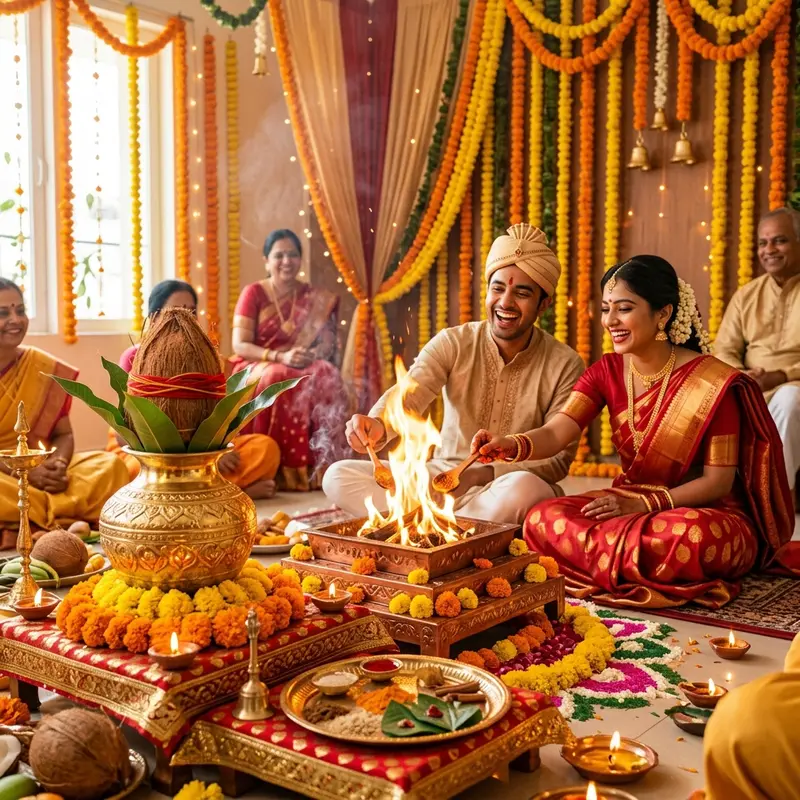
The Orchestrated Cosmos: Mastering the Ritual Marathon
An Indian wedding is not a "Ceremony"—it is a massive, multi-day theatrical production designed to invoke specific cosmic energies across three distinct realms: The Physical (Haldi), The Artistic (Mehndi/Sangeet), and The Spiritual (Pheras). You are managing hundreds of guests, caterers, and frantic vendors. The last thing you need is a spiritual conflict. Many couples treat Haldi and Mehndi as "just fun," but from an astrological perspective, these aren't parties—they are **Purification Filters**. If you start your Haldi during a "Shadow Hour," you negate the protection the ritual is designed to provide. In this 2,000-word masterclass, we provide the ultimate day-by-day timing blueprint.
The "Wedding Week" is a transition through the 5 elements. **Haldi** is the element of Earth and Fire (Purification). **Mehndi** is the element of Wood and Water (Fertility/Aesthetics). **The Pheras** is the element of Holy Fire (Transcendence). If you mis-time these, the "Bridge" to your new life becomes structurally unstable. Learn to use the **Choghadiya** and the **Panchang** to protect each step.
Automate Your Ritual Calendar
Input your final Wedding Day, and our tool will retroactively generate the absolute best hourly slots for your Haldi, Mehndi, and Sangeet, avoiding all Shadow windows.
Generate My Ritual Plan →The Cosmic DNA: The Element Transition
**Day 1: The Haldi (The Jupiter Purification).** Haldi is ruled by **Jupiter**. It is yellow, it is auspicious, and it is a cleanser. Its goal is to remove the "Buri Nazar" (Evil Eye) before the sacred fire is lit.
**The Rule:** Haldi must be completed before the Sun reaches its peak (Local Noon). Morning sun rays carry the "Prana" required to activate the turmeric. Doing Haldi in the evening is ineffective and signifies a "Drained" beginning.
**Day 2: The Mehndi/Sangeet (The Venusian Bloom).** These are ruled by **Venus and the Moon**. They are about creativity, physical beauty, and emotional flow.
**The Rule:** You must physically start the Mehndi application outside of **Rahu Kaal**. If started in the Shadow window, the bride often experiences sudden anxiety, headaches, or the color simply fails to "Take," symbolizing a lack of depth in the emotional bond. Start during an Amrit (Nectar) Choghadiya for the deepest, darkest, most protective stain.
The Numerical Matrix: Rating the Ritual Timing
In this 2,000-word analysis, we map the "Best" and "Worst" planetary windows for your sub-events.
The Behavioral Protocol: Handling the 'Makeup' Conflict
The biggest conflict during wedding rituals is between the Makeup Artist (who wants 5 hours of time) and the Priest (who wants you at the altar in 15 minutes). You must implement the "Anchor Ceremony" protocol.
The Protocol: Identify the ONE moment where the planetary alignment is non-negotiable—usually the **Varmala** or the **Sindoor**. Tell everyone (the photographer, the makeup artist, the DJ) that this specific 15-minute block is a "Hard Anchor." Build your entire buffet and dance schedule *around* that anchor. Even if the Haldi starts late because the groom is sleeping, the **First Touch** (the actual application of turmeric) must happen during the auspicious hour. The party can continue later, but the *Initial Spark* must be timed. This respects both the Social event and the Cosmic event.
Case Study: The 'Hangry' Sangeet
Mehul and Divya started their Sangeet during Rahu Kaal and a **Rog (Disease) Choghadiya** on a Friday night. The DJ's equipment malfunctioned twice. One of the primary dancers fell and twisted their ankle. The mood was irritable, and Divya felt a sense of "Impending Doom."
Why? Because Rahu is the planet of **Chaos**. If you invite the Shadow into your party, the party becomes chaotic.
They only saved the weekend by performing a small **Hanuman Chalisa** recitation on the morning of the wedding to "Ground" the aggressive Rahu energy. If they had simply delayed the Sangeet start-time by 90 minutes until the **Labh (Profit)** window opened, the technology and the mood would have flowed effortlessly. Timing is the "Oil" in the machinery of your wedding weekend.
Comprehensive FAQ Section
1. What if my Haldi is on the same day as the Wedding?
This is called a **'One-Day Wedding.'** It’s highly efficient but spiritually exhausting. Ensure the Haldi is done in the FIRST available morning Muhurat to give the energy time to "Settle" before the Pheras. You need that buffer for the protection to work.
2. Does the color of the Mehndi matter?
Astrologically, a dark stain means a strong, protective Venus. If the color is light, it means the Venus/Moon energy is weak. Use the Amrit Choghadiya to ensure a deep, soul-level 'stain' on the relationship.
3. Why shouldn't we do ceremonies at night?
Night-time (after sunset) belongs to the "Tamasic" (Descending) energies. While Sangeet is fine for the night, **Haldi and Puja** rituals should always be performed while the Sun (The Soul) is visible in the sky to act as a witness.
4. Can we play any music during rituals?
For Haldi, try to include high-vibration "Mangal Geet" (Sacred songs) or Mantras. The sound frequency (Mantra Shastra) combines with the timing to create a 4D spiritual shield around the bride and groom.
5. How do I survive the wedding-week stress?
Treat your **Moon Sign** remedies as more important than your makeup. If you are a sensitive Water sign (Cancer/Pisces), drink massive amounts of water and meditate for 5 minutes during each ritual transition. Use the stars to stay sane.
Final Takeaway
Your wedding week is the birth of your legacy. Don't let the logistics kill the light. Time your rituals, shield your energy, and remember: The catering is for the guests, but the timing is for YOU. Protect your foundation, and the party will take care of itself.